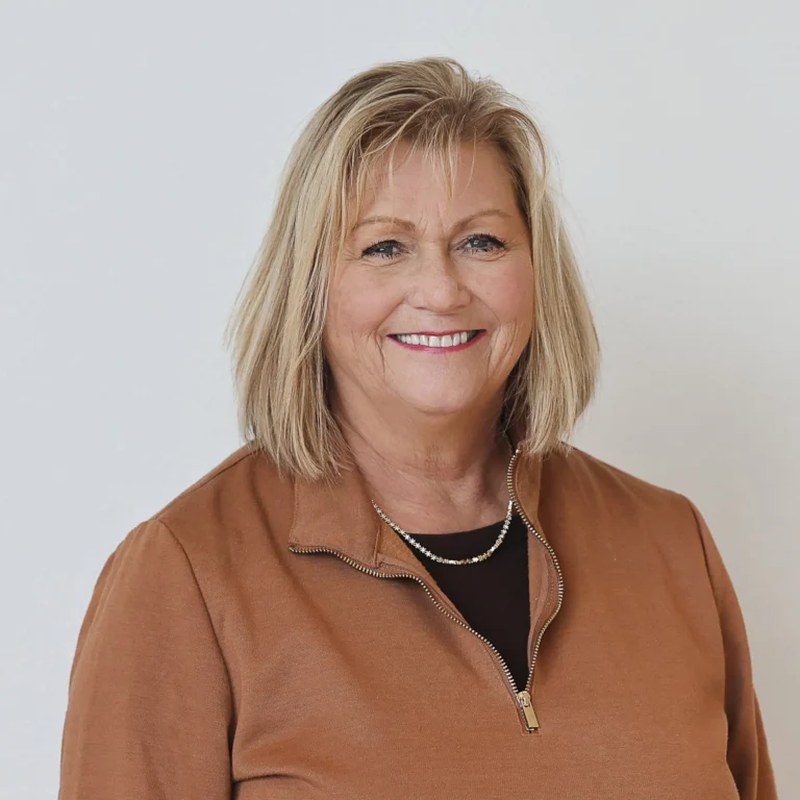
Your Providers
Five Providers. More Availability.
Psychiatric medication management and therapy from Alaska-licensed providers.
If your focus, memory, and emotional steadiness fell off a cliff in your 40s — and you keep being told it's "just stress" or "just getting older" — there may be a real, biological reason. You are far from alone.
Book an Evaluation →For a growing number of women, the years around perimenopause and menopause bring a noticeable worsening of attention, organization, follow-through, and emotional regulation. For some, it feels like long-standing struggles suddenly became unmanageable. For others, it's the first time these difficulties have ever felt out of control — and the first time anyone has used the word ADHD.
This isn't a character flaw, and it isn't a sign you're failing. There's a clear connection between the hormonal shifts of midlife and the brain systems that ADHD affects.
A note on who we are: Wellness Alaska is led by board-certified psychiatric mental health nurse practitioners (PMHNP-BC, FNP-BC), not psychiatrists. Here's the difference between a PMHNP and a psychiatrist in Alaska →
Here's the short version: estrogen helps your brain use dopamine, and dopamine is central to focus, motivation, working memory, and emotional regulation.
Estrogen supports dopamine activity in the brain — it helps your brain produce dopamine, makes it more available, and supports the regions responsible for executive function (the "command center" skills like planning, prioritizing, and staying on task). When estrogen is steady and plentiful, that system runs more smoothly. When estrogen drops and fluctuates — as it does throughout perimenopause and menopause — that support is withdrawn, and dopamine-dependent skills can suffer.
ADHD already involves differences in how the brain manages dopamine. So when declining estrogen reduces dopamine support, it can compound a system that was already working harder than most — which is why symptoms can intensify during this transition. It's a bit like a bridge that was already carrying a heavy load losing one of its supports.
A bit more detail, for the curious: Estrogen influences dopamine synthesis, release, and reuptake, and the prefrontal cortex is rich in estrogen receptors. The relationship isn't perfectly linear — working memory follows an "inverted-U" with dopamine, where both too little and too much impair performance — which is part of why women experience this transition so differently from one another.
If you've felt versions of this your whole life, the pattern may be familiar. Many women with ADHD notice their symptoms shift across the menstrual cycle — often worsening in the days before a period, when estrogen dips. Perimenopause is, in a sense, that same dip stretched out and made more permanent.
There's also a bigger story here. ADHD in girls was historically under-recognized, because the diagnostic picture was built largely around hyperactive boys. Girls who were inattentive, disorganized, or "daydreamers" — rather than disruptive — often slipped through. Many became remarkably good at compensating: lists, routines, sheer effort, and masking. For decades, those strategies held.
Then perimenopause arrives, estrogen declines, and the very coping systems that worked for years stop being enough — often right when life demands (career, caregiving, running a household) are at their peak. For many women, that's the moment ADHD becomes visible for the first time. New ADHD diagnoses among women in their 30s and 40s have risen sharply in recent years. You can read more about why ADHD is so often missed in women.
This is one of the most important — and most overlooked — questions, and it's worth getting right.
Menopause itself can cause real cognitive changes: "brain fog," word-finding trouble, slower processing, and memory lapses. These are well-documented and tend to be transient, often easing after the transition. ADHD, by contrast, is a lifelong pattern with roots in childhood.
The symptoms overlap so much that the two are genuinely hard to tell apart — and they can absolutely co-occur and amplify each other. A few distinctions that help: a lifelong difficulty with focus, organization, and follow-through (even if you compensated well) points toward ADHD, while a genuinely new change that arrived alongside other menopausal symptoms may be more about the hormonal transition — or both at once. Because girls' ADHD was so often missed, "I was never diagnosed" doesn't rule it out — old report cards, long-standing patterns, and family history can all be telling. And getting it right matters: these complaints are frequently mislabeled as anxiety or depression, which delays the right support.
This is exactly the kind of nuanced picture that benefits from an experienced clinical eye rather than guesswork.
At Wellness Alaska, our psychiatric nurse practitioners take this intersection seriously. We provide thoughtful, individualized evaluation for adults — including women navigating this midlife transition — to help you understand what's actually driving your symptoms, whether that's ADHD, the menopausal transition, or both.
Care is personalized. There's no one-size-fits-all answer here, and we won't pretend there is. What we offer is a careful assessment, clear explanations, and a plan built around you — delivered by telehealth, so you can be seen from anywhere in Alaska, whether you're in Anchorage, Fairbanks, Juneau, the Mat-Su, or a rural community far from the road system. If ADHD is part of the picture, evaluation may include objective QbCheck testing alongside a thorough clinical interview.
If any of this sounds like your experience, that recognition itself is worth something. The next step is simply a conversation.
We believe in being honest about what's established and what isn't. The link between estrogen and dopamine is well-supported by neuroscience. The specific connection between perimenopause and worsening ADHD is an active and growing area of research — the lived experience of many women is increasingly being studied, but large clinical trials are still catching up, and you may see overstated claims online (for example, that hormone therapy "treats" ADHD — something current evidence does not establish). Our approach is to combine the best available science with careful, individualized clinical judgment, and to be straight with you about both.
Selected references: Jacobs & D'Esposito, Estrogen Shapes Dopamine-Dependent Cognitive Processes, Journal of Neuroscience (2011); Kooij et al., Research advances and future directions in female ADHD, Frontiers in Global Women's Health (2025); Greendale et al., menopause transition and cognition (SWAN), Neurology (2009); CHADD, How Estrogen Affects Women with ADHD.
Many women report that ADHD symptoms — focus, memory, organization, and emotional regulation — intensify during perimenopause and menopause. The leading explanation is that declining estrogen reduces the brain's dopamine support, and dopamine is central to the skills ADHD affects. Research specifically on perimenopause and ADHD is still growing, but the underlying estrogen–dopamine biology is well-established and the pattern is widely reported.
ADHD itself is a lifelong, childhood-onset condition, but it is frequently recognized for the first time in midlife. Many women, especially those with inattentive symptoms, were never diagnosed as girls and compensated for years. When estrogen declines in perimenopause, those coping strategies can stop working and the underlying ADHD becomes visible.
They overlap heavily and can occur together, so it takes a careful evaluation to tell them apart. In general, lifelong patterns of inattention and disorganization point toward ADHD, while genuinely new cognitive changes may relate more to the hormonal transition, which tends to be more transient. A psychiatric evaluation reviews your full history, including childhood, to sort this out.
There is no strong evidence that hormone therapy treats ADHD, and you should be cautious of claims that it does. Hormone therapy is a decision made with your medical provider for menopausal symptoms. ADHD care is individualized and based on a thorough evaluation. We are honest about what the research does and does not establish.
Yes. Psychiatric evaluation for ADHD is well-suited to telehealth. Wellness Alaska provides care to adults across all of Alaska, including Anchorage, Fairbanks, Juneau, the Mat-Su, and rural communities, through secure HIPAA-compliant video.
Psychiatric medication management and therapy from Alaska-licensed providers.
If the last few years have left you wondering what happened to the sharp, capable person you used to be, let's talk. Evaluation for adults across Alaska, by telehealth.